Showing posts with label 1944-June. Show all posts

Sunday, May 27, 2012

Adak Island, 30 June 1944 -- "semi-civilian immunity"

Hello Darling...

My orders came through this afternoon. My transfer to the new post is approved. I will leave by plane as soon as it can be arranged, quite likely tomorrow. My next letter is likely to be from APO 948. 

The change is coming just in time. It will probably save me, at least temporarily, from the epidemic of GI-ism endemic here. The disease may spread to all posts in the Aleutians but I hope to be able to retain my semi-civilian immunity at least a while longer. 

The latest mark on the fever chart was the announcement that hut inspections by the officers will start on Saturday. This will be salubrious in that really efficient cleanings will be done at least once each seven days. But we all expect it to lead straight to a hospital-like, barracks-like, like-nothing-else-in-the-world regimentation of bed arrangements. As a literate corporal commented tonight, "It's bad enough to be celibate without having to be sterile."

Bacall and Bogart marching in support of the Hollywood Ten
There is a rather interesting article on Humphrey Bogart in the Life on June 12--a bit too heavy on the Luce style of goshgeewhiz adulation, but with some pretty good cracks. It seems that HB and Mrs. B battle joyfully in their spare time. One day in running away from a crowd of autograph hunters (and muttering "filthy little monsters" as he ran) HB slammed the car door in his wife's face. "Why you cheap little ham actor," she started and gained momentum with each syllable. The kids listened in awe. Finally one shut his autograph album with a snap and said reverently, "Gee, she's even tougher than he is."

I must get some sleep, my darling. More tomorrow. 

M

Adak Island, 28 June 1944 -- "not even faintly flattering"

It seems I am always packing.

My change to APO 948 has been approved, at least by all local powers, and currently I am sweating out receipt of orders from Seattle. I am supposed to be ready to go at a moment’s notice when the orders to arrive, so today I reloaded my barracks bags. 

I will probably travel by Milair: by Army transport plane. That means my total weight allowance is 300 pounds, including myself. So I will have to ship one of the barracks bags. Most of my packing time was spent wrapping books in old socks, long underwear and wilted fatigues.

Now the bags are untidily lined up beside my bunk and there they may remain for weeks and weeks, this being the Army. On the other hand, I may be out of here at any time. You had better begin writing to the new address…

Springfield rifles in sunnier days
I have several hopes about the trip. One is that I do go by air. Another that it is a clear day, for I can imagine no more beautiful scenery—especially as I will be going in the right direction. I would also like to go before Saturday as on that sad occasion there is going to be an inspection of rifles. This is in line with the re-GI-ing of the post in general and the ACS in particular. My weapon, which hangs on the wall behind my clothes, is an old Springfield, an ’03 which I suspect hasn’t been fired since the Battle of the Marne. Getting it ready for inspection would be like getting Haj ready for a dog show.

The reactions to my impending departure were not even faintly flattering. Hoiman (“The Goiman”) West said, “Scheiss. There goes the typewriter.” Paul declared, “They can’t do that to us. Not when you just got the hotplate.” And Ray rumbled, “You can’t go until I’ve finished reading the book (Barnes’s Intellectual and Cultural History of the Western World).” Of such stuff popularity is made. 

In a way I hate to leave. Especially the hut. While it is crowded and usually too hot [Murray thought anything above about 55 was too hot, an attribute that suited him well to later life at Trout Lake], it nevertheless is what I am used to as an Aleutian home. And we have been improving it steadily. Since I have come we have built a couple of walks leading into it, shoveled dirt around the edges so that the wind no longer whips through the floor, erected a urinal  and put up the storm porch which Perry purloined. Currently the engineers in the hut are planning a running water sink and an oil pipe running to the fifty gallon drums which sit outside the hut.
But there are certainly compensations, even as to leaving the hut. We have become a poker hut, one in which a game is always in progress. This means steady noise, cigar smoke solid enough to fill chinks in the floor, and occasional bad feelings. For me it has been an especially bad development because the games are always played at our end of the hut and it is practically impossible even to keep a lien on my typing stool, much less to concentrate on writing. 

In my last letter I mentioned that I was going to replace Terry Moore, a friend of the Elliotts and Jameses. The subconscious of a former sports editor must be permanently warped. The man I meant was Johnny Moore. Terry Moore exists. In fact there are a couple of them: (A) an infielder with the Giants; (B) a welterweight who once fought 12 rounds with Barney Ross.

Good Bill Green has a letter from Moore describing his station. Moore was not particularly enthused, but his unhappiness seemed to stem from the fact that he was not doing the same sort of work that he and Gene had done in Seattle. He spoke of going on a fishing trip and seeing fox and caribou, which would indicate a more interesting assortment of wildlife than we have here. 

It is true what the strange sailor told us about worms. On the other hand, there are increasing numbers of birds—the early ones of which are bound to be disappointed. We are also getting an early spring influx of insects, including some surprisingly sturdy limbed daddy-longlegs. At one time this forlorn foxhole was commercial foxhole. A trapper bred blue fox hereabouts. I saw his shack the other day. When things were the worst in this area, he turned loose his animals and took to the hills. Later he was evacuated, and now he is back, serving the Army in a civilian capacity. It is said that his foxes are reproducing madly and that if he can round them up after the war he will be in the money. But that is rumor. I haven’t talked to anyone who has seen any of the critters. How they keep hot here I don’t know.

When you finish The Telephone Booth Indian (and by the way, I haven’t received any New Yorkers recently), you had better turn to the Mark Twain set and read “Life on the Mississippi” because that is the number one project on our postwar list—just while we are deciding where to go next. And I would also sort of like to show the Columbia who is boss. Box Canyon still bothers my conscience. And so do the last two hundred miles of the Danube.

I see the Republicans not only went back to 1920 to get a Harding candidate who represents zero squared, but made the farce complete by picking another Coolidge as the vice presidential candidate. Looks like we have to vote for that man again. (How about the straight Prohibition ticket?) Up here all tidings of the Republican doings were received with momentous unconcern. I doubt that the Demo conventions will raise any more excitement.

Dewey and Gover
From the fact that Willkie immediately congratulated Dewey, I assume that he is going to follow the oldest of political axioms: If you can’t beat ‘em, join ‘em. Of course there is always the excellent chance that he was always with them

One of the more interesting things should be watching the Luce publications chew up all those nasty things they have been saying about Toothbrush Tom. (Did you notice the repetition of the joke which came out after Dewey was pictured with his Great Dane: “I’m going to vote for the big man with the little dog.”) There was an amusing editorial in a recent Life entitled “Advice to the Republicans.” In it, Life said that it was “non-partisan” but would choose between the GOP and Democratic candidates later. It advised the GOP to think twice before nominating Dewey. By implication, at least, it was for Taft or Bricker. Ugh. 
Roosevelt, Fala, and Ruthie Bie

We had a swell letter from Howard Lewis yesterday. I’ll send it along as soon as I have finished it. Somebody pulled the wrong card from a file and he was yanked right out of his beautiful Miami Beach project and deposited, unadmittedly disgusted, at the Muroc Army Air Field—right in the middle of the Mojave Desert. He is doing publicity work there and still talks as though he expects to be sent overseas before the business is over, although I suspect that his eyes will keep him home. [Howard was in fact sent to Italy, where he earned a Bronze Star.] He sold his “Why I Fight” essay to “This Week,” the New York Herald Tribune Sunday supplement, for $250. Distinctly not fodder.
There is a short story in the June Harper’s, “Look at Miss Memford,” which you should not miss. Neither should Phyllis. John-Boy’s Harper reviews are progressively poorer. He seems to me to be busy justifying himself for becoming wealthy out of his writing. He should take his money for granted and quit rationalizing. He has a lot to say of more interest.

Keep writing, my sweet. Your letters are so wonderfully like you.
M

To Phyllis and Otto Goldschmid: Adak Island, 25 June 1944 -- "life up here is exactly as it was, only more so"

Dear two…

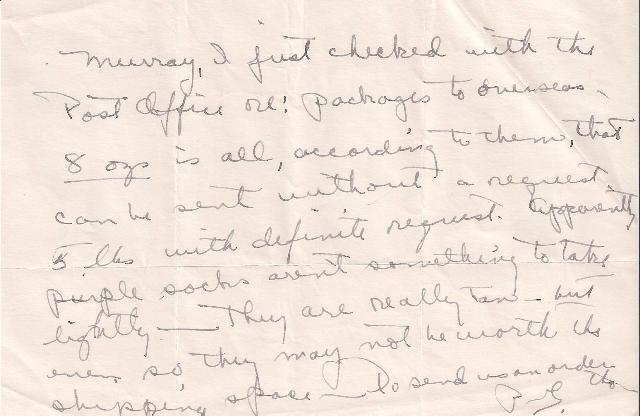
This will serve as a requisition for socks in whatever state of repair and of whatever strangeness in construction. Have you considered darning them with built-in holes at the heels to save wear and tear and also time? 

One of the quaint characters at large on this outpost already has a pair of purple stockings, a first pair at that. He wears them as a scarf. And one of the kids in our hut—Perry, the misplaced MP—got a pair from his girl. They were so small that he put a piece of pipe in one and has it hanging by his bed as an improvised billy stick.

As for the fudge, there is nothing I like better than fudge in my stockings. Christmas or otherwise. But what do you people use for sugar these days? I do not recall any beets blossoming in the backyard, or even a good government printing press in the garage?
Your letter, dated June 19, and the letter you and Rosa wrote from the houseboat, dated June 19, came in the same mail. I suspect tequila, or maybe the U.S. has gone on a doubletalk calendar since I drew this term of exile in Estatiland. 

Life up here is exactly as it was at the time I wrote before, only more so.  As one of the more profound philosophers in the operating room recently remarked, “There comes a time when monotony gets damned monotonous.”

We don’t hear the Corwin show up here. Why, I don’t know. It is the only one outside of the symphonies and “Information Please” that I really would like to hear. The shows that we hear are mainly those broadcast over a local station run by the army. The music and general amusement programs are sent up on records with the advertising removed. So far we are still getting shows that I heard while in Seattle. They sound much better with the blather about buying abridged.  …

The news programs that we hear are shortwaves from San Francisco and transcribed for rebroadcast over the local outlet. We hear them about an hour after they originate. Since these shows also serve as our shortwave propaganda news they are a bit strong on the sugar and leave one feeling mentally diabetic. Whenever possible I try to get a CBS outlet at home. I feel very possessive about the job Columbia is doing on radio reporting.
Down from the tree in August 1944: Bill Walton is at left, Robert Capa at right, and Ernest Hemingway in the middle.
(Ernest Hemingway Photograph Collection, Kennedy Library)
Remember the time you came up to the Time office with Rosa? I believe you met one of my roommates there, Bill Walton, a big, blue-eyed, baby-faced blond who looked as if he would be a bit afraid crossing a busy street. I see in the current Time that he jumped out of a place with a bunch of paratroops in the Normandy Invasion and got stuck, typewriter and all, in a pear tree. He had a nice boxed story in the War News of the edition with Eisenhower’s picture on the cover.

[Walton went on to become a painter, a good friend of John F. Kennedy (whom he encouraged to run for President) and the head of the federal arts commission. His New York Times obituary is here:

His Time column about the landing is at
http://www.time.com/time/magazine/article/0,9171,1101440619-640079,00.html
It starts like this:
I plunged out of the plane door happy to be leaving a ship that was heading toward flak and more Germans.The jump was from such low altitude there was only a moment to look around in the moonlight after my chute opened.
The fields looked so small that one couldn't miss a tree or hedge. Anyway I couldn't. I landed in a pear tree-a rather good shock absorber. But the trouble was I didn't filter on through to the ground; instead I dangled about three feet above ground unable to swing far enough to touch anything.
My chute harness slipped up around my neck in a strangle hold, covering the knife in my breast pocket. I was helpless, a perfect target for snipers and I could hear some of them not far away.In a hoarse, frightened voice I kept whispering the password, hoping someone would hear and help. From a nearby hedge I heard voices. I hung still a moment, breathless.
Friends. Then I heard them more clearly. Never has a Middle Western accent sounded better. I called a little louder. Quietly Sergeant Auge, a fellow I knew, crept out of the hedge, tugged at the branches and with his pigsticker cut my suspension cords. I dropped like an overripe pear ]
Getting back to the radio programs for a moment – I think it would take Corwin to make Wolfe bearable. Let me know if he does a number on my man Steinbeck.

You mentioned “Lady in the Dark” but do not say what you thought of it as a movie. Rosa and I saw it not long before I shipped out. We found it wildly amusing. The idea of an editor of a smart New York magazine being naively surprised at the basic elements of psychiatry, of a psychiatrist shouting at his clients, and of a girl who didn’t care about clothes wearing those tailored creations that Ginger Rogers had curving around her were all edging toward the surreal. And the dream sequences had all the dreamlike quality of a rare beefsteak or a two ton bomb. I did rather like the touch, though, of having Jon Hall appear in a dream standing beside a symbolic stallion.

Here is a dream for you to practice on. I had a dream that an order came out that everyone on Alaskan duty had to walk on his hands. And we all found it very easy to do. But I had great difficulty in typewriting while standing on my hands.

Speaking of shows, don’t miss “Gaslight.” In the first place, Ingrid Bergman. But besides that , it is a beauty of a job, just as good as it was as a play. …

Thanks again in advance for the fudge and footgear. And don’t forget the letters. (And here’s a hint for economy—it only takes six cents to airmail letters to an APO number.)
Best to both,
Murray

Saturday, May 26, 2012

from Phyllis Goldschmid to Murray in the Aleutians, 19 June 1944 -- "we have been wondering whether your feet get cold"


Dear Murray, 

We were surely glad to get your letter and learn that you are safely wherever you are and that your life is not too disagreeable there. As a matter of fact we envy you the good library and the time to read. And your hutmates sound quite glamorous for the place, but I’m afraid that’s not the word to describe such a band although they sound at least like characters in a Gilbert and Sullivan opera.

We have been wondering whether your feet get cold where you are and if you have socks warm enough. At any rate I just learned to knit and I’m sending you the first pair. Of course they are purple and have quite a few critical mistakes, but I’m sure that with a little real effort you’ll be able to get them on and shape them to your size twelves. Incidentally, my pattern was a forlorn pair of army socks found behind a chest in the upstairs bedroom just a few months ago. How they got there I don’t know….but I finally identified them as yours by the hole in the heel. I took them to the USO one night and darned them but you must try to remember that I never darn Otto’s socks and that I think it’s much easier to knit a pair than darn them in that shape…and I do really.

We were surely happy to have Rosa and Carmen down. I’m awfully glad Carmen can be in Seattle with Rosa for she (Carmen) is surely a wonderful girl and good company for her (Rosa) who is a wonderful girl too I might add. We tried to sell them the idea of working in Shelton where life is so much nicer than in Seattle but I’m afraid they are settled.  At any rate we are counting on them to visit us often. 

Do you hear the Norman Corwin program there? They are working thru a trilogy on Americana literature and last night broadcast parts of Thomas Woolf. It was really very nice. Incidentally, I hope you heard Fred Allen when he had Norman Corwin as a guest star and presented on of his famous dramas with Corwin sound effects. I haven’t read any of Woolf’s works…I was scared away by his reputation of ponderosity, but I may take a stab at it now.

We saw our first movie in months, “Lady in the Dark” because Otto likes Ginger Rogers and I like movies. We then came home to delve into Freud and have lived in a horrible state of psychoanalysis ever since…in which every mistake has some devious subconscious meaning. We have actually had very little luck however in resolving our neuroses because I can’t remember my dreams and Otto claims to have none. Perhaps we just don’t have any neuroses. The study is extremely interesting however, and we would be delighted to quote reasonable rates to our friends for complete analysis.

We had a wonderful day yesterday. Otto got his first sailing in since Europe. I think you met the Waltons here.…those two nice giants. Their boat is a dandy and the wind was perfect. Otto was in his glory.

We hear thru the grapevine that Camilla is coming along well and will probably be thru with casts and braces before too long. We are indeed happy for her. 

We are thanking you for the job you did in pulling our potatoes last year for you missed a few and they are producing now. We will be happy to send you a bushel if you’d like.
We’ll send the socks right away whenever I can get some fudge think enough to hold its shape even where it’s cold. This atmosphere is very bad for fudge making. If the socks aren’t G.I. perhaps you can trade them to the natives.

Yours,
Otto and Phyllis


Adak, June 14 1944 -- "my smugness amazes even me"


My Darling…


I did not write yesterday but instead sent you a little booklet which the Army gave all of us. It tells about the Aleutian campaign from the bombing of Dutch Harbor until the present. Dashiell Hammett wrote it and some of the local artists drew the illustrations.


On the whole the booklet is an excellent job. And I imagine that it will fill a need. One of the minor gripes around here is that the folks at home do not know anything about the war in this area—its history and current problems. This booklet was designed especially to send home. The Army even furnished the envelope and instructions about postage.

Dashiell Hammett and Adakian staff: Diane Johnson collection

On the other hand a few jaundiced GIs have expressed a fear that the homebodies, receiving these fancy pamphlets, will say “they must not be having much of a war up there to be able to turn out books like this.”
This has been another good day for everything but sleep. I “won” mail call by a mile: two letters, a book, a New Republic, a New York Times, a PM. One of the letters was a bill from Fortune (I hope you have sent them a check for six dollars) but the other was from you. It was the one you wrote in answer to my D-Day letter, which made the round trip in eight days. That is the best time yet and makes me feel very close to you, my plikka.

You mention that Mrs. Usedane is due to spend a night at the house, and that you hope to get a picture of her to send to me to give to Bill. I hope you can do it. But I don’t think she will be coming over. Bill told me some time ago that she had accepted the invitation in theory rather than in practice because, much as she enjoys Jean, she is tired out by long sessions with her. She is hard at work on practices for a recital she is to give at the University this summer: Brahms, Beethoven and Bartok.

Another visitor you are not likely to have is Virginia Green, Bill Green’s wife, whom I told you might come to talk about Mexico. Bill wrote to her about us and suggested the visit. Yesterday he received her answer. He showed it to me. Of you she said, “People like that scare me.” Of me she said, “I don’t believe I would like Murray. Isn’t he rather temperamental? And he sounds sort of smug. I think you had better find out about Mexico from him.”

I think that her opinion of you stems from my once telling Bill that I had convinced you that we should only entertain people who interest us. From something Bill said while he was writing a let6ter one night, I think he attributed the idea to you. As for her opinion of me, I think that it shows that Bill must write a rather good letter. His reporting of personalities, if not of direct quotes, seems to be accurate.

My smugness amazes even me. I am so superbly satisfied with the way we live. To be more accurate, with the way we lived and will live. I like our friends, I like our dwellings—not even excepting a certain cockroach cubbyhole in mid-Manhattan, I like our books, I like our records. For that matter, I sort of like you. I am even smug about my smugness, verdad?

But one thing which I object to very strongly in myself is my theoretic liking for “the people” and my actual dislike of a very large number of individual people. My attitude toward them is, I fear, supercilious. I have formed several deep dislikes for men simply because they represent attitudes to which I object. On the other hand, I believe I have managed to conceal my dislikes. And I have not mentioned them to anyone except you.
You are right in your estimates of Bill Usedane. He is reserved, intelligent and gentle. Only once, in fact, has he really let down the bars in talking to me. That was the night of the invasion. We sat up in the personnel hut and talked the sun into the sky. He has written a short story on anti-Semitism, somewhat like my “Smart Boy” piece. It is based on an experience he and his wife had on their honeymoon.

They stayed at a rather fancy and very empty beach resort. Everything about their stay was pleasant, in fact, idyllic. On the last day, just as they were about to leave, the complimented the proprietress on the appointments of the rooms and the overall décor of the establishment. She said, “Oh yes, we cater to a very good clientele, people who respect quality. And we keep the Jews out.” It was Mrs. Usedane’s first contact with overt anti-Semitism.

My other good friend here, Vern Jackson, is due to be transferred soon to another post. I will miss him. But in a way his move may work out to my advantage. In the first place, I may stay on the graveyard censor detail. I have grown to like it better than any other work I have done here. Considering my negative reaction to the first days on the censor desk this constitutes quite a change. But the days go pretty fast on graveyard and censoring seems more interesting than crypto. Jackson has had a long run on the graveyard detail and since I am filling in for him now I can hope to have an equally long tenure.

This would have another advantage. Vern has been going over to the supply warehouse, about half a mile from here, every night and practicing the violin from 6 until 10 or 11. I am going to see if I can’t “borrow” the warehouse for that period now to do my writing. It would be a real chance to work in complete solitude—and I can think of nothing more appealing. I have tried to write for the last three days in the hut, but there is always the radio and a very noisy card game and occasional roughhouse interruptions. Also there is the temptation to spend all day playing chess with Ray Howe, who is now leading me eight games to six. The warehouse would be the perfect solution. I will see the officer in charge tomorrow and let you know how it comes out.

I am editing the first six chapters of the novel, and have made a few changes. For one thing I lengthened the shooting scene at the end of the first chapter in an attempt to heighten the suspense. I have brought a bit more political interpretation into chapter three where Angel meets the Indian. And I have lengthened the fifth chapter somewhat t raise doubts as to whether the killer really caught the train and also to point up the inefficiency and political duplicity of the local police. I intend to retype the whole forty pages in a day or two and will send you a carbon of the new business.

About the sinarquistas. You mention an article in the May 29 PM. I don’t get the Sunday edition up here, so if you could commandeer the article—or get another at the stand in front of the downtown post office—it would be helpful. The delivery of papers up here is perplexing. I still get an occasional PM or Time for April. Today’s pair were the Times for the 18th of May and PM for the 22nd. The PM had the second of two articles the first of which has not arrived yet. Confusin but amusin, to quote the sage of Dogpatch.

Deliveries of packages seem to be even farther off schedule. So far I have received the slippers and the bed lamp and one of the books, Sunburst, which came today. I think the things you send yourself come faster than those Bill [James] handles. By the way, what give with Bill? And I have another request. It will probably make you laugh. I’d like some vitamin pills. Either the shotgun variety or those with lots of sunshine. The yellow stuff is rather a minus quality here, and so far green vegetables. 

You asked in today’s letter for a copy of the answer to Woody’s ends and means [Woody Wirsig]. I’ll remember the carbon paper. He is logically correct of course. To deny yourself support from demagogues you dislike is to deny yourself power. On the other hand, as Jacqueline [Ford] once pointed out, there are no such things as ends and means. Each act is an end in itself. The links in the chain are of equal value and brass means do not alternate with golden ends. A bad act remains a bad act. I still shy away from the unfavorable act regardless of its consequences. Woody looks at the consequences and weighs between them and the desired second act. His view is the only workable one. It is pragmatically correct. Granted power, I suppose I should have to accept it. But while the discussion remains theoretical, I can quibble. And while quibbling, I can justify myself on the grounds that, as Koestler quotes, a change in the means automatically changes the ends. “Show us not the goal without the trail.” I’ll be writing Woody in a day or two. I wrote Pete, and Carmen, and Bill yesterday.
All my love, darling. More tomorrow,
M

Adak, D-Day report, 3 am Tuesday, June 6, 1944 -- "they say it is the real thing"


Dearest Nunny…

We got the news at 9:57. I was working on the swing shift at the time.

The work was routine and everyone was very bored. Lou Cooley, my partner on the desk, was at the far end of the operations room, Rotarianing with some of the boys. The traffic chief, a short, blue-eyed, red-faced Swede had opened a front door because the oil stove was overheating and I was arguing with him to close it because the draft was cold on my legs. He yelled “did you ever work next to a hot stove” and I yelled “did you ever work with a cold wind on your legs.” The guys near the stove tried to drown me out and the guys near the door tried to drown him out. The switchboard phone rang and I went over to it. In the evenings the censors handle the ACS phone switchboard.

I always have a  hell of a time with the contraption. This time I expected more trouble than usual because two calls were coming in at once. I answered and a real excited voice said, “The invasion’s started. Tell the boys.” I said thanks and started flipping switches to answer the other call. On the second try I got the ringing party. He said, “Let me speak to Coolie.” I called Lou and as he came to the phone I told him quietly the invasion had started. He said “Sure,” and answered the phone. Then he said, “What! When?” He turned to me and said “The invasion’s started. Somebody just picked it up over the local station. They interrupted a regular program to put it out. Tell the fellows to turn on the radio.”
 
I yelled “Hey fellows, the invasion is on. Turn on the radio.” The room froze. Everyone looked at whoever was nearest him. The spell broke immediately. No one believed it. I shouted “Honest!” and ran back to tell the boys who were locked in the crypto room. 
 
Jensen, the traffic chief with whom I had been arguing went to the switchboard and started twisting dials. No amplifiers were free and he put on a pair of headphones. Everyone clustered around him except Cooley, who was working the switchboard which was going mad. There was little excitement. No one really believed it. Half a dozen of the fellows said “remember the AP gal who punched out a story like that by mistake.”

Jensen said, “They say it is the real thing. Eisenhower’s headquarters. Official announcement.”

“I won’t believe it,” a tall rosy cheeked boy said. “I won’t believe it.”
“Yeah, after all this time…”
“It had to come sometime, why not now?”
“Why now…?”
“Shuttup. What’s he saying JJ?”
“I can’t understand them now at all.”

Jensen put down the earphones and I picked them up and listened at one while another man listened at another. Someone was talking very rapidly through a blur of static. I could not catch a word. I gave up the receiver.

A stack of messages had accumulated on the censor desk for, in spite of the excitement—the  dull, shocked, strange excitement—the key men in the room were still at work. I went back to my desk and started censoring. The wind from the open door still whipped about my legs but they were no longer cold. My hands were like ice though; each finger seemed a fist. My chest was tight with excitement and when I was writing it felt as though I had to move my entire torso to move the pencil. I suddenly realized why I had not been able to understand the speeches on the radio. They had been in French.

By a quarter past ten the invasion was an accepted fact. The talk had swung to where the landings had been made. One rumor was Dieppe, another at L’Orient, still another Dunkirk. Finally someone phoned from one of the huts to say that it was officially announced that the landing was on the northern French coast. A few moments later it was narrowed to Normandy.

“Good,” said Lou, “that’s right next to Holland.” Cooley is one of our local strategic optimists but the elimination of the Pas de Calais area and all of Belgium from the European front is a bit exuberant even for him. I kept myself from correcting him, though. Not out of politeness but simply because I was thinking of an island and a church and an omelet with ashes in it. Normandy in June. Somebody came in to say that a report on the pre-invasion bombing was that the coastal area had been pounded by tremendous aerial formations, that in some areas observers felt nothing could have survived the naval and aerial bombardment. Normandy in June and omelets at St. Michel, and croissants and chocolate in a tiny bakery and a fenced off spot where a king was forced to do penance. [Normandy was one of the first stops on Murray and Rosa's honeymoon, five years before.] I told Lou that Normandy was west of Holland by a couple of hundred miles. He didn’t argue.

The talk shifted to strategy. Would we hit Holland too? Would we attack Norway? Would we hit Southern France? Ignoring the Alps, Lou insisted our troops would drive overland from Rome into the Riviera. Somebody suggested Greece. Another Bulgaria. What would Russia do? Where would the Russians attack. How much longer for the war in Europe? Three weeks. You’re crazy, three months.

Aw, we’ll be lucky to finish it this year. This year! Christ man, we’ll be hitting them from all sides. How they going to stand that?

What do you think the Japs’ll do? Oh the hell with the Japs, how’d you like to be in Paris tonight? Or Berlin? 

That sort of talk carried us through until quitting time. The graveyard shift brought in extra details fished from the short wave. The Germans had made the first announcement. Radio Tokyo had had some reports on the fighting. Tokyo claimed there were big air battles in progress. Our radio said we had absolute air supremacy over the Channel and that resistance on the beach was surprisingly light. 

Big arguments were going on at several points about the time difference between here and London. This argument was extremely foolish, because, after all, we operate on Greenwich Time. Our day begins at two o’clock in the afternoon of which is really the day before. In other words we are ten hours behind London. But some of the arguments had us really, two days ahead of them. They must have done it with War Time.

The bull sessions lasted all the way to the mess hall. Just as I was leaving the operations building, [Bill] Usedane and Vern Jackson—the two men I feel closest to in this outfit—came in. They had been climbing our local mountain and missed the first announcements but had been listening attentively and intelligently since reaching their huts. We all three looked at each other, silently. Bill said, “I’m glad our remarks were wordless.” We smiled at each other and passed on.

Everyone was hungry at the mess hall. The radio was booming. The local station’s corporal commentator, an incredibly boring boy, was droning on about channel topography and promising to keep us all informed. Somebody yelled “turn that bastard off and get some music.” Somebody turned him off but got San Francisco which was giving a resume of the news. 

It was the first journalistically presented account we had had. Everyone was quiet, eating pork steaks and pears. A few were frankly not interested in the news. One of them read the cartoons in a January issue of Colliers, and another, the boy who had said he wouldn’t believe about the invasion, kept reading the latest issue of the ACS news bulletin. He occasionally read items aloud. 

After dinner I stayed by the radio. Russ MacDonald, one of the crypto men, and Junior Huttala, the Elma Finn, stayed on, as did a couple of KPs—but they had to. We finally picked up WABC. I heard CBS covering the invasion. They did an excellent job. It made me feel very useful, listening to that show.

And now it is very late. Bill Usedane and I have just settled the fate of the nations. We’re agin em. Seriously, it was a good bull session. I delight in finding someone moodier than I.

Your letter today (#8) was excellent. About it, more tomorrow. Until then, goodnight my sweet. I love you so very much.
M